

Table of Contents
- The Psychology of Tangibility: Why Paper Invitations Feel More Special Today
- Digital Fatigue and the Growing Appeal of Physical Mail
- Digital vs Paper Invitations Pros and Cons
- The Unboxing Experience: More Than Just an Envelope
- Etiquette for Wedding Invitations and Formal Occasions
- When to Send Out Invitations for Your Event Timeline
- How to Word Formal Invitations That Guests Keep
- Heirloom Value: Why Paper Invitations Outlast the Event
- Frequently Asked Questions
Last Updated: September 27, 2026
The Psychology of Tangibility: Why Paper Invitations Feel More Special Today
Paper invitations feel more special today because they are increasingly rare. In a world where most event details arrive as a text message or a social media post, a physical card demands attention in a way a screen notification cannot. At The Invite Lady, we have watched this shift firsthand since 2009: clients who once asked for digital-only options now request printed suites for their closest guests.
The reason is not nostalgia alone. It is biology. Your brain processes a physical object differently than a digital one, and that difference shapes how you remember the event itself.
How Touch Triggers Emotional Memory
Touch is the first sense to develop and the last to fade. When you run a fingertip across a piece of cardstock, receptors in your skin send signals to the same brain regions that store emotional memory. Digital images bypass this entirely.
That is why guests pin a paper invitation to the refrigerator and forget a Facebook event within a day. The card becomes a physical anchor for the occasion. A common mistake is treating this as sentimentality rather than function. In practice, it is the most reliable RSVP tool you have.
Digital Fatigue and the Growing Appeal of Physical Mail
Digital fatigue is the exhaustion people feel after hours of screens, notifications, and app-based communication. It is why a mailbox containing a real envelope now produces a small jolt of pleasure rather than obligation.
Consider how much digital mail your guests already ignore. Evites get buried under work emails. Group texts get muted. Paper invitations are the only category of mail people open eagerly, because the format itself signals that something worth their time is inside.
The USPS mail volume and household mail trends show that households now receive far less personal mail than a decade ago, which makes each piece that does arrive stand out more, not less. Scarcity creates value. A paper invitation benefits from that scarcity without trying.
Digital vs Paper Invitations Pros and Cons
The usual pros-and-cons list treats this as a cost-and-convenience decision. That framing misses the real trade-off. The two formats do different jobs, and the job paper does is the one guests remember.
| Factor | Digital Invitations | Paper Invitations |
|---|---|---|
| Cost per guest | Low to none | Higher per card, plus postage |
| Delivery speed | Instant | Days via mail |
| Guest experience | Convenient, easy to miss | Tactile, hard to ignore |
| Formality signal | Casual to moderate | Formal and ceremonial |
| Keepsake value | Rarely saved | Often framed or kept |
| RSVP tracking | Automatic | Manual or QR code |
| Memory anchor | Fades with the notification | Persists on the refrigerator, in a box, in a frame |
Pros of digital invitations:
- Arrive instantly and update in real time
- Easy guest list management and reminders
- Lowest cost for large guest counts
- Practical for events where details are still shifting
Cons of digital invitations:
- Easily buried in crowded inboxes and muted threads
- Feel casual, even for formal occasions
- Almost never kept as a memento
- Compete with every other notification on the guest's phone
Pros of paper invitations:
- Create a tactile experience guests remember
- Signal formality and effort before a word is read
- Become keepsakes and family records
- Cut through digital noise because they arrive so rarely
Cons of paper invitations:
- Higher cost and postage
- Require lead time for print production
- Manual RSVP tracking unless you add a QR code
- Address list errors are expensive to fix after printing
When Digital Works Best
Digital invitations work best for casual, large, or last-minute gatherings: office parties, informal cookouts, or events where the guest list keeps changing. For a 200-person holiday open house, a digital save-the-date plus a printed card for VIP guests is a sensible split.
The Trade-Off Most Comparisons Skip
A cost-per-guest table makes paper look like the expensive option. It is, on a per-unit basis. But the comparison ignores what the guest does with each format afterward.
The Unboxing Experience: More Than Just an Envelope
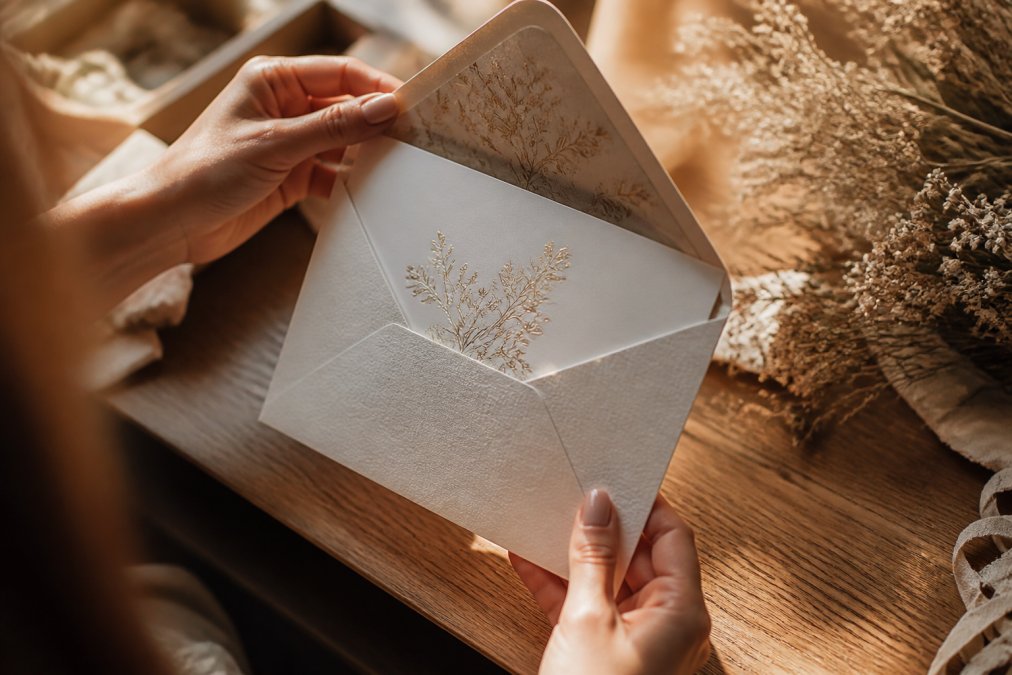
The unboxing experience starts before the card is even visible. A textured envelope, a printed liner, and a wax seal or foil accent turn opening the mail into a small ceremony. Guests slow down. They pay attention.
Etiquette for Wedding Invitations and Formal Occasions
Etiquette for wedding invitations and other formal events follows a few durable rules: the host is named, the request is clear, and the dress code and RSVP details are explicit. Everything else is style.
Traditional etiquette holds that:
- The host's name appears first, spelled in full
- Titles are spelled out, never abbreviated
- The RSVP date falls two to three weeks before the event
- Reception details go on a separate enclosure card if the guest list differs
- The reply card carries its own stamped, addressed envelope
Why Etiquette and Paper Are Wired Together
Formal etiquette developed alongside printed stationery, and the two still reinforce each other. A spelled-out title, a full host name, a separate enclosure card, these conventions exist because a printed card has room for them and a screen notification does not.
A Wording Structure That Holds Up
[Host name] requests the pleasure of your company at the [occasion] honoring [guest of honor] on [day], [date] at [time] [Venue name and address] [Dress code] RSVP by [date] to [contact or QR code]
The Etiquette of the Keepsake
One rule most guides leave out: a formal invitation is written to be kept. That changes how you proofread it. A digital invite can be corrected with a follow-up message. A printed card cannot.
When to Send Out Invitations for Your Event Timeline
Send invitations six to eight weeks before the event for local guests, and eight to twelve weeks for destination or out-of-town guests. Save-the-dates go out six to twelve months ahead for weddings and large milestone events.
| Time Before Event | Action |
|---|---|
| 6-12 months | Send save-the-dates, book venue |
| 8-12 weeks | Finalize guest list, order invitations |
| 6-8 weeks | Mail invitations |
| 3-4 weeks | RSVP deadline, follow up with non-responders |
| 2 weeks | Final headcount to vendors |
How to Word Formal Invitations That Guests Keep
A reliable structure looks like this:
[Host name] requests the pleasure of your company at the [occasion] honoring [guest of honor] on [day], [date] at [time] [Venue name and address] [Dress code] RSVP by [date] to [contact or QR code]
Heirloom Value: Why Paper Invitations Outlast the Event
That is the work The Invite Lady has done since 2009: helping hosts turn a date on a calendar into something guests can hold. With personalized printed and digital options, flexible per-card ordering, and many themes for baby showers, graduations, and religious milestones, we make it simple to send an invitation that feels as special as the occasion. American Greetings Association on the enduring value of printed cards
Frequently Asked Questions
Are paper invitations still considered more formal than digital?
Yes. For weddings, baptisms, and other formal occasions, paper invitations remain the standard for black-tie and religious ceremonies. The weight of the cardstock, the foil stamping, and the hand-addressed envelope signal that the host invested time and care. Digital invitations work well for casual gatherings, but when the event calls for tradition, a formal invitation on quality paper carries a level of respect that email cannot replicate.
What are the benefits of sending physical invitations for events?
Physical invitations create a tactile experience that guests remember. They sit on a counter or get pinned to a fridge, serving as a daily reminder of the upcoming event. Paper invitations also carry sentimental value and become keepsakes after the celebration. For hosts, the act of mailing invitations forces earlier planning, which helps with guest list management and event logistics. The tangible nature of paper simply holds attention longer than a digital notification.
Do guests prefer receiving paper invitations over email?
Many guests do, especially for milestone events. A paper invitation feels like a gift rather than an obligation. It signals that the host considers the guest important enough to warrant the cost of postage and print production. That said, younger guests or those with busy schedules may appreciate a digital save-the-date as a supplement. The strongest approach often combines both: a digital reminder for logistics and a paper invitation for the emotional impact.
Is it worth the cost to send paper invitations for a party?
It depends on the event and your budget planning. For a casual backyard gathering, digital invitations save money and time. For a wedding, baby shower, or graduation, paper invitations set a tone that digital cannot match. The cost covers custom design, print quality, and postage. Many hosts find that ordering per card keeps costs manageable, and the keepsake value makes the expense feel justified long after the event ends.
The challenge is not choosing between paper and digital. It is deciding which guests deserve the experience of opening something real. The Invite Lady offers customizable designs, per-card ordering flexibility, and coordinated themes for every milestone, so you can send invitations that guests keep long after the event ends. Get started with The Invite Lady and give your celebration the tangible opening it deserves.