

Table of Contents
- Why Small Quantity Wedding Invitations Are Easier Than You Think
- How Many Wedding Invitations to Order for a Small Guest List
- Choosing a Design, Paper, and Finish for a Small Run
- Print at Home vs. a Print Service: What Works for Small Batches
- Your Wedding Invitation Proofing Checklist Before You Approve
- Wedding Invitation Turnaround Time and Deadline Planning
- Frequently Asked Questions
Last Updated: October 6, 2026
Why Small Quantity Wedding Invitations Are Easier Than You Think
Ordering a small batch of wedding invitations is simpler than most couples expect. The trick is knowing your household count before you shop, and choosing a printer that sells by the card rather than by the box.
That last part matters more than anything else. Many couples assume a small order means paying a penalty, or getting stuck with a minimum they will never use. It does not have to work that way. At The Invite Lady, we have helped families celebrate life's big moments since 2009, and we price per card so a 15-invitation order costs what 15 invitations should.
Below, we will show you exactly how to order small batches of wedding invitations, from counting households to approving your proof. We will also cover how to order small batches of wedding invitations without wasting money on extras you do not need.
How Many Wedding Invitations to Order for a Small Guest List
The number of wedding invitations you need equals your household count, not your guest count. Add roughly 10 percent for extras, then round up to the nearest batch size your printer offers.
That is the whole formula. Most couples overcount because they picture seats at the reception instead of mailboxes.
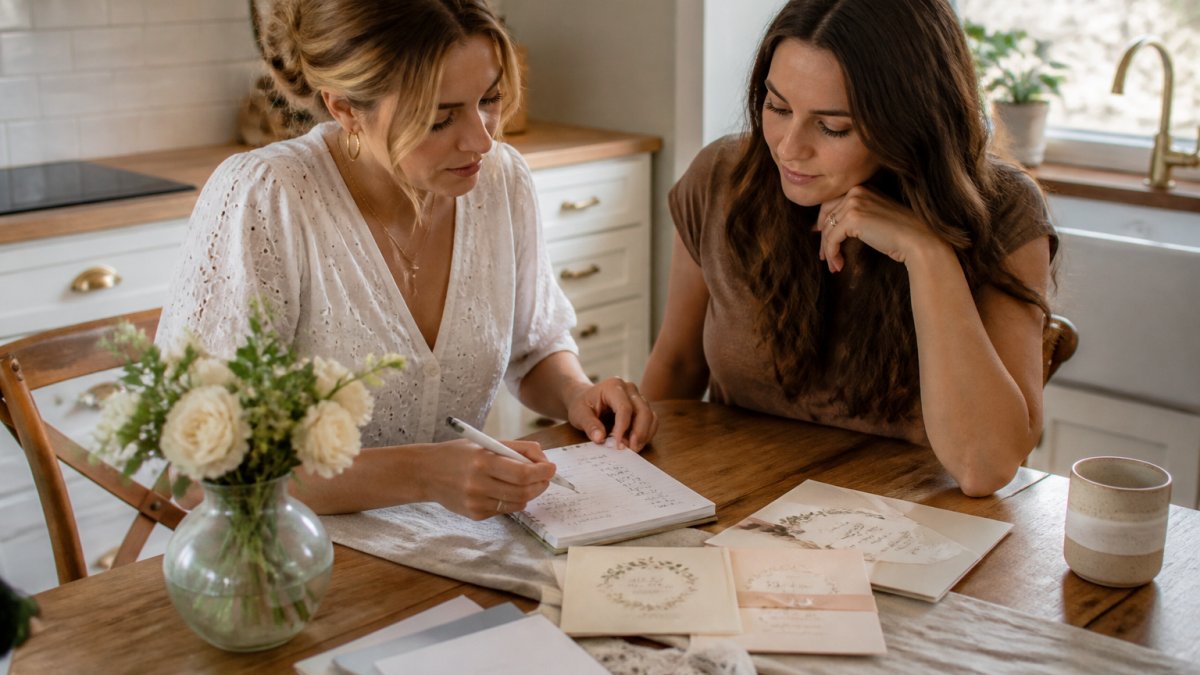
Households vs. Guests: The Counting Rule That Saves Money
A household is anyone who shares an address. A family of five gets one envelope, not five. A couple living together gets one envelope, not two.
Follow these steps to build your count:
- Write out every guest name you plan to invite.
- Group names by mailing address.
- Count the groups, not the names.
- Add 10 percent for last-minute additions and keepsakes.
- Round up to your printer's batch size.
A 60-guest list often works out to 30 to 35 households. That is half the envelopes, half the postage, and half the cost.
Should You Add Extra Copies?
Yes, but keep it small. Order a few extras for keepsakes, for the photographer, and for anyone you add late.
A common mistake is ordering 25 extras "just in case." In practice, most couples use two or three. A handful of extras covers the realistic scenarios without inflating your total.
Choosing a Design, Paper, and Finish for a Small Run
Small runs give you more freedom, not less. With fewer cards to print, you can pick a heavier paper stock or a specialty finish without blowing your budget.
Here is what to weigh:
- Design: Choose a template you can personalize, or ask for a custom layout. Both work at small quantities.
- Paper stock: Thicker cardstock feels more formal. Standard matte stock keeps costs down and mails easily.
- Finish: Matte is the safest choice for readability. Foil and letterpress add cost per card, so they hit harder on small runs.
- Size: A standard 5x7 inch invitation fits most envelopes and needs no extra postage.
- Envelopes: White or cream are usually included. Colored or lined envelopes cost more.
Print at Home vs. a Print Service: What Works for Small Batches
Most couples compare only the sticker price and skip the two costs that actually decide a small run: minimum order quantity and file setup. A fair comparison weighs quality, convenience, minimums, and total cost together.
Here is how the four common paths stack up for a small batch:
| Option | Typical minimum | Best for | Real trade-offs |
|---|---|---|---|
| Print at home | None | 10-20 invitations, simple one-color designs | Ink or toner cost per sheet, color drift page to page, cardstock feed jams, no bleed support on most home printers |
| Local print shop | Often none, sometimes 25 | Quick pickups, basic matte cardstock | Limited paper and envelope choices, in-person proofing only, counter hours |
| Online print service | Frequently 25-50 per design | Custom layouts, specialty paper, foil or letterpress | Setup or plate fees on some finishes, shipping time, digital proof rounds |
| Digital-only invitations | None | Tight budgets, fast delivery, small guest lists | Guests who prefer paper, no keepsake, deliverability and spam-filter risk |
The costs that surprise small-batch buyers
Three line items show up on nearly every professional quote and rarely appear in DIY estimates:
- Setup or plate fees. Foil, letterpress, and some digital presses charge a one-time setup per design or per color. On a 20-card run, a setup fee can rival the printing itself.
- Shipping. Small runs ship in flat boxes or rigid mailers, not standard envelopes, so expect a shipping charge that does not shrink with quantity.
- Envelopes and addressing. Blank envelopes are often included; printed return addresses, liner, and guest addressing are usually priced per piece.
File preparation for a small run
If you supply your own artwork, most print services expect:
- Bleed: 1/8 inch (0.125 in) beyond the trim on all sides, with background art extended into it.
- Trim size: 5 x 7 in is the standard invitation; confirm the final size before you build the file.
- Resolution: 300 ppi at final print size. A 72 ppi web image will look soft on paper.
- Color mode: CMYK for print, not RGB. Convert before exporting, and expect some shift from what you see on screen.
- Fonts: Embed or outline them, or export a flattened PDF.
- Paper compatibility: Heavy cardstock may not feed through a home printer; check the printer's rated weight before buying a 110 lb or 120 lb stock.
Proofing before you commit
A digital proof confirms layout and spelling. It does not confirm color. For color-critical designs, request a physical printed sample or a press proof. On a small run, one reprint can erase the savings of ordering fewer cards.
Your Wedding Invitation Proofing Checklist Before You Approve
Never approve a proof without reading it out loud. Typos hide in plain sight, and a reprint costs both money and time.
Run through this list before you hit approve:
- Both names spelled correctly, including middle names
- Date, day of the week, and year all match
- Venue name and address are correct
- Time is listed with AM or PM
- RSVP date gives guests at least three weeks
- RSVP contact info works (phone, email, or website)
- No missing words or doubled words
- Colors match your palette in print, not just on screen
- Envelope addressing matches your guest list
Have one other person read it too. A fresh set of eyes catches what you have read past a dozen times.
Wedding Invitation Turnaround Time and Deadline Planning
A small batch does not shorten the production calendar. It shortens the print run, but proofs, drying time on specialty finishes, and shipping still take the same number of days. Plan backward from your RSVP date, not forward from your order date.
The small-batch ordering workflow, step by step
- Lock the guest list and household count. You cannot order until this is final, because reprints at small quantities cost nearly as much as the original run.
- Choose design, paper, and finish. Confirm the printer stocks your paper at your quantity. Some specialty stocks are only sold in larger sheets.
- Prepare and submit files. Include bleed, correct color mode, and embedded fonts. Ask for the printer's template.
- Approve the digital proof. Read it out loud, then have a second person read it.
- Request a physical proof if color matters. Add three to five business days for this step.
- Approve for press. Production starts only after this approval, not before.
- Production. Digital printing typically runs faster than foil or letterpress, which may need drying time between passes.
- Shipping and delivery. Small runs often ship flat in rigid mailers, which can cost more and arrive in a different window than standard mail.
- Address, stamp, and mail. Leave a buffer here for hand-addressing if you are not using a calligrapher or printed addressing.
A realistic timeline
Working backward from a wedding date:
- RSVP deadline: at least three weeks before the wedding, per common etiquette guidance.
- Guest response window: one week after mailing for local guests, longer for out-of-town.
- Mail time: two to five business days for domestic delivery.
- Production: roughly five to ten business days for standard digital printing; longer for foil, letterpress, or hand-finishing.
- Proofing: one to three days for a digital proof, plus three to five days if you request a physical proof.
- File prep: one to three days if you are building the artwork yourself.
That puts a comfortable order date about five to six weeks before the wedding, and earlier if your date falls near a holiday, when print shops and shipping carriers both slow down.
When you are short on time
If you are inside four weeks, the order of operations changes:
- Skip specialty finishes. Foil and letterpress add the most schedule risk.
- Ask about rush production before you order, and confirm the rush fee in writing.
- Consider digital invitations for the full list and a small printed run for keepsakes or older guests.
- Print at home only if you have already tested your printer on the exact cardstock you plan to use.
Frequently Asked Questions
Can you order just a few wedding invitations?
Yes. Many stationers, including The Invite Lady, price per card rather than enforcing a large minimum order, so you can order 10, 15, or 25 invitations without paying for extras you do not need. This works well for intimate ceremonies, vow renewals, or when you only need invitations for a handful of households.
How far in advance should you order wedding invitations?
Order early enough to allow for proofing and shipping. A safe plan is to finalize your guest list and wording, then place your order at least four to six weeks before you want invitations in guests' hands. If your event is sooner, ask about rush production and expedited shipping before you order.
What should you check before approving a wedding invitation proof?
Review names, dates, times, venue address, RSVP details, and spelling. Check that the design, paper stock, and envelope color match what you selected. Read the proof out loud to catch typos, and have a second person review it. Once you approve, the file goes to print, so catch errors before you sign off.
Can you order extra wedding invitations after the first batch?
Often, yes, but reprints may cost more per card and can vary slightly in color or finish from the original run. Order a few extra copies up front to cover last-minute guests and keepsakes. If you do need a reprint, contact the stationer with your original order details to match the design as closely as possible.
A small guest list should not mean a big headache. The couples who order smoothly are the ones who count households first, proof carefully, and give themselves a few extra weeks. The Invite Lady makes that easy with pricing per card, personalized printed and digital designs, and a wide range of themes for every kind of celebration. Get started with The Invite Lady and order exactly the number of invitations your day calls for.