

Table of Contents
- Start With a Stationery Selection Framework
- Nail Your Baby Shower Invitation Wording
- Pick Baby Shower Invitation Themes That Carry Through
- Plan the Baby Shower Save the Date Before Anything Else
- Build a Baby Shower Stationery Suite, Not Just an Invitation
- Compare Paper, Printing, and Finishes Without Overpaying
- Budget and Quantity Planning for Baby Shower Stationery
- Proof, Order, and Mail: A Production Checklist
- Frequently Asked Questions
Last Updated: October 19, 2026
Start With a Stationery Selection Framework
The fastest way to choose baby shower stationery is to lock four decisions before you browse a single design. Answer those four, and the rest of the process moves quickly.
At The Invite Lady, we have helped hosts build shower paper since 2009, and the pattern holds: hosts who decide in order avoid the reprint spiral. Hosts who shop by look alone end up ordering twice.
Here is the framework:
- Format: printed card, postcard, or digital invitation
- Quantity: how many guests, plus extras
- Theme: the design direction that ties everything together
- Budget: total spend, split across pieces
Get those four on paper first. Then start shopping.
The Four Decisions That Drive Every Order
Each decision narrows the next one. Format sets your mailing plan. Quantity sets your print run. Theme sets your design. Budget caps the whole thing.
Hosts who skip straight to design usually come back to these later. That costs time and money.
Nail Your Baby Shower Invitation Wording
Baby shower invitation wording needs five things: who is hosting, who the shower is for, the date and time, the location, and how to RSVP. Everything else is optional.
Keep the wording warm but plain. Guests should not have to read it twice.
A simple structure that works:
- Opening line: "Please join us for a baby shower honoring [name]"
- Date and time: spelled out in full
- Location: full address, including any unit number
- RSVP: name, phone or email, and a reply-by date
- Registry or theme note: one line, if you have one
Inclusive wording matters: not every guest knows the baby's name or gender, and not every family shares that before birth. "Baby [last name]" or "a little one on the way" works for everyone.
Pick Baby Shower Invitation Themes That Carry Through
Baby shower invitation themes work best when they carry into the whole party, not just the card, a theme that lives only on paper looks disconnected once guests walk in. Start with one you can repeat in three places: the invitation, the decorations, and a small party supply detail like napkins or a cake topper.
Themes that hold up well:
- Woodland animals: deer, fox, bunny, and raccoon motifs with soft greenery
- Sunshine: warm yellow tones and "You Are My Sunshine" wording
- Classic neutral: simple script and a single color palette
- Seasonal: fall leaves, spring florals, or winter greenery
Pick one and stay with it, mixing two themes is where showers start to look busy. Our A Little Ray of Sunshine Baby Shower Invitation shows how far one theme can stretch: the watercolor sun and script lettering set a tone you can match in balloons, signage, and a welcome sign.

Plan the Baby Shower Save the Date Before Anything Else
A baby shower save the date goes out before the invitation, usually four to six weeks ahead for a local shower and earlier for out-of-town guests. It is a short heads-up, not the full invitation.
Keep it to the essentials:
- The date
- The general location or city
- A note that formal invitations follow
Save the dates can be a printed postcard, a magnet, or a digital card. Magnets stay on the fridge, which helps guests remember; digital versions move faster and cost less. Order save the dates and invitations together when you can, matching designs look intentional, and one order means one proofing round.
Build a Baby Shower Stationery Suite, Not Just an Invitation
A baby shower stationery suite is the full set of paper pieces for one event, designed to match: the invitation, save the date, inserts, thank-you cards, and small extras like raffle tickets.
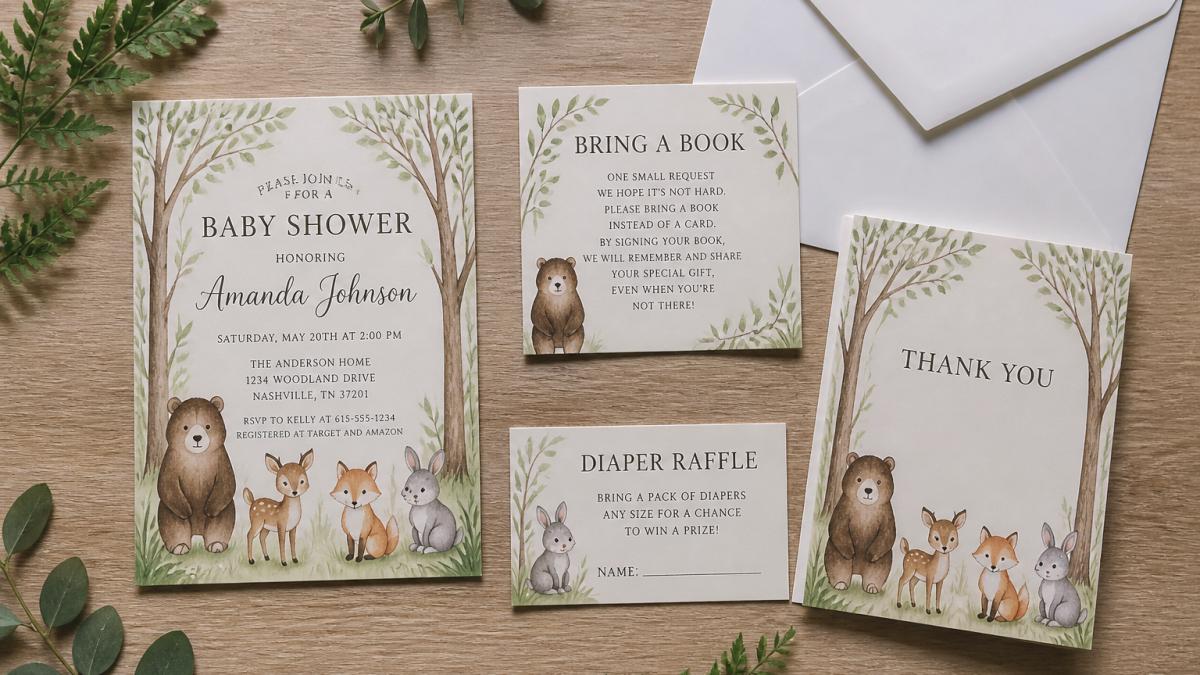
Suites matter because guests see several pieces before the shower ends. When they match, the whole event feels considered.
A typical suite includes:
- Invitation: the main piece, mailed first
- Insert cards: registry details, bring-a-book requests, or diaper raffle tickets
- Thank-you cards: sent after the shower
- Welcome sign: the same design, scaled up for the door or gift table
Our Boho Woodland suite shows the idea in practice. The Boho Woodland Bring a Book Card asks guests to bring a favorite children's book instead of a card. The Boho Woodland Diaper Raffle Ticket adds a game element. The Boho Woodland Baby Shower Thank You Card closes the loop afterward, in the same deer, fox, bunny, and raccoon design.


That is the difference between an invitation and a coordinated celebration.
A Little Ray of Sunshine Baby Shower Invitation →
Compare Paper, Printing, and Finishes Without Overpaying
Paper weight, printing method, and finish each change how a card feels in hand, how it reads across a room, and how it survives the mail. Most shower hosts do not need the heaviest stock, they need pieces that match the job each one does. Start with paper weight: cardstock is measured in pounds (lb) or points (pt), and the numbers are not interchangeable across mills, so compare within a single shop's listings. A few working ranges:
- 80-100 lb text or 8-10 pt cover: light and flexible, folds cleanly, mails at a standard first-class rate. Good for insert cards and save-the-date postcards.
- 100-120 lb cover or 12-14 pt: the common invitation range. Firm enough to stand on a gift table, still flexible enough to go through automated postal sorting without cracking.
- 120-130 lb cover or 14-16 pt: a keepsake feel. Heavier stock can push a folded invitation over the one-ounce first-class threshold, so check postage before you commit to a full run.
Texture matters as much as weight. Smooth stock prints fine detail and small type cleanly. Felt or linen textures hide fingerprints and feel expensive, but they soften thin serif strokes and tiny script, avoid them for small RSVP details. Cotton stock takes letterpress beautifully but costs more and absorbs ink differently than coated stock.
Finish is the third lever:
- Matte: no glare, takes pen ink well, and photographs cleanly. The default for wish cards, advice cards, and anything guests write on.
- Gloss: colors pop, but it reflects light and smears some pens. Reserve it for bright themes where the artwork is the point.
- Satin or soft-touch: a middle ground that reads upscale without the glare of gloss.
- Foil and letterpress: raised or metallic effects that look striking on an invitation but can make small type harder to read. Keep foil to the headline or a single motif, not the RSVP line.
Print method changes both cost and feel. Digital printing is the workhorse for short runs and full-color designs, handling small quantities without a plate setup charge. Offset printing becomes more economical at higher quantities and delivers more consistent color across a large run. Letterpress and foil stamping are specialty methods, beautiful on an invitation, usually overkill on inserts guests read once.
A practical allocation: put the heavier stock and any specialty finish on the invitation and thank-you cards, keep inserts and raffle tickets on standard smooth stock, and use matte anywhere guests will write. That split keeps the budget where guests actually notice it.
Budget and Quantity Planning for Baby Shower Stationery
Budget and quantity planning starts with the guest list, not the design catalog.
Quantity formula. Start with the number of invited guests, not expected attendees. Add 10 to 15 percent for lost mail, last-minute additions, and keepsakes.
Split the budget by piece, not by pack. Invitations carry the largest share because they set the tone and get the most handling.
A working allocation for a printed suite:
- Invitations: the largest single line, roughly half of the printed budget
- Save the dates: a smaller line, often a postcard or magnet
- Inserts and game cards: the smallest printed line
- Thank-you cards: budget for one per gift, plus a few spares
- Postage: price it per assembled envelope, not per card
Per-card versus per-pack ordering. Per-card pricing lets small showers order exactly what they need without buying a 50-count pack for 18 guests.
Avoid rush fees. Standard production plus shipping takes time, and expedited turnaround usually carries a surcharge.
Proofing is part of the budget. A reprint costs the full piece price again plus shipping and lost time.
Digital invitations are the low-cost option when the guest list is large or the timeline is short.
Proof, Order, and Mail: A Production Checklist
Proofing catches the mistakes that cost you a reprint. Read every piece out loud, then have a second person check it.
Run this checklist before you order:
- Spell every guest name correctly, including the honoree
- Confirm the date, day of the week, and time match
- Check the full address, including unit or suite numbers
- Verify the RSVP contact details work
- Confirm your reply-by date leaves enough time to finalize the headcount
- Read the wording aloud for awkward phrasing
- Check that colors match across every piece in the suite
- Confirm quantities and minimum order quantities at checkout
- Order one extra of each piece as a keepsake
After ordering, mail invitations six to eight weeks before the shower for local guests, adding two weeks for out-of-town guests. Keep a few spares for anyone who loses theirs. If something looks off when the box arrives, contact the shop right away, a real person on the other end of the order is worth more than a lower price.
Planning a shower means a hundred small decisions, and the paper is the one guests see first. Start with our sunshine design or the Boho Woodland set, and build the rest of your stationery around it. Shop All Invitations and get the paper settled before the guest list grows.
Frequently Asked Questions
What stationery do you actually need for a baby shower?
At minimum, you need invitations and thank-you cards. Most hosts also add one or two inserts, such as a bring-a-book card or a diaper raffle ticket, plus a welcome sign for the gift table. A coordinated baby shower stationery suite keeps all of these pieces visually consistent. Order thank-you cards at the same time as invitations so you are not scrambling after the shower, and add a few extra invitations for keepsakes or last-minute guests.
When should baby shower invitations be sent?
Send printed baby shower invitations six to eight weeks before the shower date. That gives guests enough time to clear their calendars, arrange travel, and RSVP before you finalize the food and favors. If the shower falls near a holiday weekend or requires out-of-town travel, send them eight to ten weeks out. A baby shower save the date can go out even earlier, around ten to twelve weeks ahead, so guests hold the date before the formal invitation arrives.
Should baby shower invitations match the party decorations?
They should share a color palette and mood, not necessarily match every item. Pull two or three colors from your baby shower invitation themes and repeat them in balloons, table linens, and the cake topper. A sunshine invitation in warm yellows pairs naturally with golden table accents. Coordinating stationery with decorations makes the event feel intentional, and guests notice when the welcome sign and thank-you cards carry the same design as the invitation.
Can baby shower invitations be personalized?
Yes. Personalization covers the guest of honor's name, shower date, venue, registry details, and any special instructions like bringing a book or diapers. When you order from a stationery shop, request a digital proof before printing so you can catch typos or color issues. Keep the wording warm and clear, and include an RSVP date at least two weeks before the shower.